The Oversaturation of AI in Consumer Products
Vinay Bhola is an Associate at KS&R, boasting over eight years of experience in market research and brand strategy. He excels as a liaison between clients and their target audience, leveraging advanced research methodologies and a deep understanding of the marketplace to deliver strategic, actionable insights. Vinay holds a firm belief that the key to insightful market research is listening to the data—it always tells a story, but the meaning must be interpreted.

When “AI-Powered” Becomes White Noise
Artificial intelligence has rapidly moved from innovation to expectation. What was once a differentiator is now a default feature across products, services, and marketing claims. As AI labeling expands into everything from home appliances to vehicles to workplace tools, KS&R’s Social Insights Exchange (SIX) team set out to examine whether consumer enthusiasm is beginning to erode, and whether constant AI integration may be creating unintended resistance.
As one threads user @pbose40 observed:
“AI used to sound exciting. Now in 2026, many people roll their eyes when they hear it. Why? Because everything is called “AI-powered” even simple apps, toothbrushes, and boring emails. When a word is used for everything, it stops feeling special.”
That sentiment reflects a broader shift: when innovation becomes ubiquitous, its signaling power weakens.
When Innovation Feels Unnecessary
As AI capabilities have advanced, companies are developing new ways to infuse intelligence into everyday and appliances in our lives. Recently, several major brands unveiled a series of “smart” refrigerators, washing machines, and other connected home products. While technologically impressive, these launches also sparked debate about whether AI meaningfully improves the core function of such products.
One reddit user, @own-key1782, wrote: “Once upon a time, a washing machine just washed clothes and a fridge kept food cold. Now we have got AI-powered washing machines and fridges that need Wi-Fi. Like… why does my fridge need to “learn my habits”? Just do your job!”
Another user, @leatherrebel5150, echoed the sentiment: “No appliance is ever worth getting a “smart” version of. Just more stuff to go wrong.”
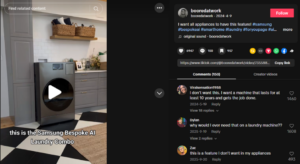
Consumers comment about their concerns on Samsung’s new Bespoke AI Laundry Machine on TikTok.
The Differentiator to Fatigue
For a segment of consumers, AI integration has shifted from intriguing to overwhelming, with the value proposition still unclear. According to Circana, nearly a third of consumers don’t want AI in their products, with most consumers indicating they just want their devices to do their job.
Social conversations reinforce this sentiment. As one Bluesky user, @forge, commented: “I don’t need my fridge to be ‘smart.’ I need it to keep food cold. That’s it, stop, complete, finished product.”
Similarly, reddit user @ok_personality6148 shared, “I was recently shopping around for a new TV and was ‘somewhat’ surprised to see all these AI TV models. I say somewhat because everyone is putting AI into everything right now but I thought a TV could be left alone.”
Importantly, this fatigue does not necessarily reflect anti-technology attitudes. Rather, it suggests a rising expectation that innovation should justify its presence. Consumers are increasingly evaluating AI not on novelty, but on tangible improvements such as performance gains, time savings, personalization that feels relevant rather than intrusive.
When “AI” Becomes a Marketing Label
Beyond questions of utility, some consumers are challenging the legitimacy of AI, viewing it as marketing jargon used to entice them into purchasing products. As one threads user, @ahsan.mangal.ads, noted: “Sometimes it feels like AI is more about the buzz than real benefits.”
A user on Reddit expressed a similar perspective: “The marketing departments and management think that their customers want AI. No matter if it’s useful or not.”
These views point to a potential credibility risk. When AI becomes a blanket descriptor applied across categories, it risks losing meaning. If every product is positioned as intelligent, the term no longer differentiates. Over time, this may erode trust, particularly if consumers struggle to identify clear, functional improvements tied to the AI claim.
What This Means for Brands
As technology companies continue advancing AI capabilities, a strategic question emerges: will competitive advantage come from adding more intelligence—or from applying it more intentionally?
Mozilla recently added an option to users of Firefox to disable GenAI Features. This move signals recognition that not all users want AI embedded by default. Whether other companies follow suit remains to be seen. The next phase of AI adoption may be defined less by how much intelligence can be added and more by how clearly it improves the experience. For brands, the challenge is no longer simply whether to integrate AI. It is whether that integration reduces friction, enhances performance, or solves a meaningful problem.
If the answer is unclear to consumers, “AI-powered” may begin to feel less like innovation and more like excess.
About KS&R
KS&R is a nationally recognized strategic consultancy and marketing research firm that provides clients with timely, fact-based insights and actionable solutions through industry-centered expertise. Specializing in Technology, Business Services, Telecom, Entertainment & Recreation, Healthcare, Retail & E-Commerce, and Transportation & Logistics verticals, KS&R empowers companies globally to make smarter business decisions. For more information, please visit www.ksrinc.com.