

This cardiology insights page is grounded in healthcare marketing research, using physician-led data to reveal how cardiology is evolving and where challenges persist.
A New Era in Heart Health
A nationwide survey of 429 U.S. cardiologists reveals a pivotal shift towards AI and minimally invasive procedures, setting the stage for a revolution in cardiology.
KS&R, in partnership with EMI, embarked on a nationwide survey to capture a detailed snapshot of the challenges and technological advancements in cardiology. As part of our broader healthcare marketing research, this report offers a window into the day-to-day realities of cardiologists, who deal with an array of patient conditions and evolving treatment methods. The study also sheds light on the growing importance of market research in healthcare, where understanding physician behavior, patient complexity, and system constraints is critical to informed decision-making.
“Cardiology is at a pivotal juncture, with unprecedented challenges and innovations transforming the field,” states David Ouellette, KS&R Healthcare Director. “Our extensive survey of 429 U.S. Cardiologists has revealed critical insights into the challenges Cardiologists face with managing their patients as well as the development of key trends such as a shift towards less invasive procedures and the increasing reliance on advanced technologies like AI. These advancements are reshaping how we approach heart health care, improving both the management and treatment of patients with heart conditions. However, our study also highlights the significant issue of patient compliance and the necessity for enhanced patient education to improve treatment outcomes.”
David Ouellette,
KS&R Healthcare Director
Years In Clinical Practice
Primary Clinic Location
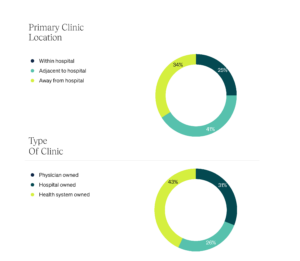
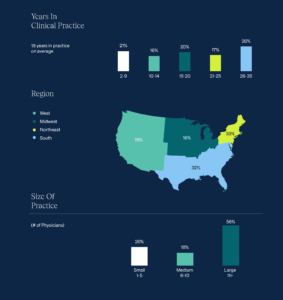
Derived from a diverse cohort of cardiologists, including Electrophysiologists and General Cardiologists, with varying years of experience (2-35 years) and from different practice settings, this report brings forward a rich, multifaceted perspective on the profession. All participants are board-certified, actively practicing clinicians who provide a deep, experiential understanding of the field’s current state and its future trajectory.
Patient Comorbidities
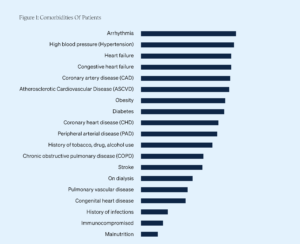
Cardiologists treat patients with a wide range of conditions from arrhythmias to heart failure to chronic obstructive pulmonary disease and many others. It goes without saying that each of these conditions present varying challenges for these physicians in terms of how the patients are treated, what their care pathway is, and how compliant the patients will be, to some extent. While the indications and treatment pathways are different, there are common threads to all of these as far as potential for medication, procedures, data, etc., that can impact a Cardiologists practice and how they treat and manage these patients. One thing that stands out is that patients aren’t being treated for just one condition – they have multiple co-morbidities that adds to the complexity of managing each patient. Cardiologists are telling us that they are not only seeing more patients, but in some respects are also seeing “sicker” patients.
Figure 1: Comorbidities Of Patients
Biggest Challenges Managing These Patients
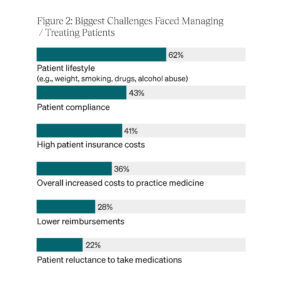
From patient compliance to practice efficiency, market research healthcare studies like this one help surface challenges that may otherwise go unseen. In fact, the patients themselves present some of the biggest challenges as a result of their lifestyle and compliance.
Patients are their own worst enemy when it comes to their lifestyle whether it be weight, smoking, alcohol abuse, lack of exercise, etc. Physicians are in a position where they need to provide guidance on lifestyle changes to prevent further cardiac issues. Physicians can provide educational materials or suggest lifestyle changes, but if the patient is not able or willing to comply then their condition is only going to get worse.
In fact, Patient Compliance is the 2nd biggest challenge Cardiologists face, even more so than insurance or cost challenges. Until patients take their health into their own hands this will continue to be a challenge.
Our findings also indicate that Cardiologists who have a higher proportion of female and minority patients tend to select Patient Compliance as a significant issue more often. This suggests that these groups may face additional barriers to compliance, highlighting the need for Cardiologists to make a more concerted effort around patient education and
tailored communication strategies.
While Cardiologists look to do what’s best for the patient, they also manage financial pressure that can factor into the care of their patients, particularly as it relates to high insurance costs.
As new treatments and procedures become available, it’s important to recognize the potential implications those have on insurance, reimbursement, and overall costs for these physicians.
Figure 2: Biggest Challenges Faced Managing / Treating Patients
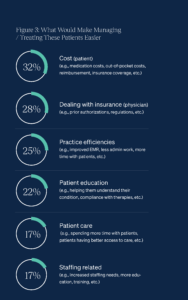
Not surprisingly, lowering costs for the patients and making it easier to deal with insurance (particularly prior authorizations) would go a long way in managing and treating patients.
While those financial components will help, physicians also acknowledge that there are efficiencies that could take place within their practice that would help improve patient care whether it be the need for more staff, improved EMR systems, and reducing the amount of time spent on administrative work. Freeing up time will allow physicians to spend more time with patients, where they can educate and reinforce compliance.
Interestingly, those who have been in practice a long time focus more on costs and insurance. This trend is notable among Cardiologists practicing in the Northeast, suggesting that regional dynamics and perceptions of costs and insurance can vary significantly.
“Affordable medications, prior authorization elimination, better reimbursement.”
“Better drugs, insurance companies doing their job instead of killing patients by denying treatments, more societal interest in losing weight and exercising, better EMR.”
Conversely, those just getting started in their practice are feeling immediate impacts of needing more staff and improved patient education. Notably, patient education is a pressing concern in practices with a higher minority population.
“Patient education and understanding of disease process. More affordability of the treatment. Less time having to do PA’s. Less time having to do EHR (that is the worst part of medicine today). Competent NP’s / PA’s.”
“More support from ancillary staff including RN, PA, techs, etc. that would offload physician burden to focus on more sick patients who need help.”
Figure 3: What Would Make Managing / Treating These Patients Easier
Biggest Trends In Cardiology
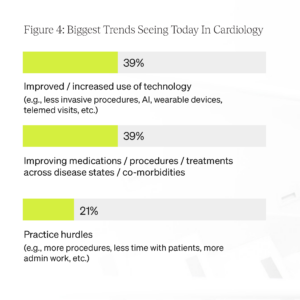
Cardiologists acknowledge advancements in medications, treatment options, technology, and a shift towards less invasive procedures. However, they also face significant practice challenges.
While Cardiologists are benefiting from advancements in medications and increased use of technology, these improvements do not necessarily translate to lower costs. On the contrary, there is a trend of rising expenses and reduced reimbursement rates.
Beyond the rising costs, there are other significant trends in cardiology. These include spending less time with patients, an increase in administrative work, and treating a higher volume of sicker patients, which results in more time spent performing procedures.
“An increased focus on technology for both patients and physicians. A focus on lifestyle modification as the first step in disease reduction.”
“The explosion of technical advances, medications, and treatment options in this field over the last 5 years.”
“Newer treatment options that are very expensive and not always covered by insurance; more minimally invasive options for treatment.”
Figure 4: Biggest Trends Seeing Today In Cardiology
“There is a lot of innovation with new medications, procedures with the goal to reduce hospitalizations and increase survival.”
Future of Cardiology
Current trends in cardiology are expected to persist, with continued advancements in medications and treatments, as well as increased use of technology, particularly AI. These improvements range from enhanced medications and genetic testing to targeted therapies and a continued shift towards less invasive or non-surgical procedures.
The impact of these advancements on individual practices remains to be seen. However, it is crucial to ensure that despite these innovations, costs are controlled and do not result in additional work for cardiologists. This will enable them to spend more time with their patients.
Additionally, these findings are relevant to organizations conducting market research in the pharmaceutical industry, where understanding cardiologists’ needs, treatment adoption, and reimbursement pressures is essential.
“Use of artificial intelligence in all aspects of cardiology and genetic manipulation as a cure to disease.”
“New technology improving the lives of patients with cardiovascular disease, offering safer and more effective treatment that will improve overall health.”
“Cardiology is changing more than any other field in medicine. Who knows where we’ll be in 10 years? Where we are now is completely unlike where we were just 10 years ago!”
Insights like these underscore why market research pharma teams rely on physician-led studies to guide strategy, messaging, and investment decisions.
These findings also reflect how healthcare marketing research can help organizations better understand physician realities, patient complexity, and the real-world impact of innovation in cardiology.
About KS&R
KS&R is a nationally recognized strategic consultancy and marketing research firm that provides clients with timely, fact-based insights and actionable solutions through industry-centered expertise. Specializing in Technology, Business Services, Telecom, Entertainment & Recreation, Healthcare, Retail & E-Commerce, and Transportation & Logistics verticals, KS&R empowers companies globally to make smarter business decisions. For more information, please visit www.ksrinc.com.